| 2.Scenic Spots:
Forbidden City
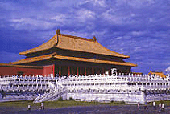 This
is the Palace Museum, also known as the Purple Forbidden
City. It is the largest and most well preserved
imperial residence in China today. In 1987, the
United Nations Educational, Scientific and Cultural
Organization recognized the Forbidden City as a
world cultural legacy. This
is the Palace Museum, also known as the Purple Forbidden
City. It is the largest and most well preserved
imperial residence in China today. In 1987, the
United Nations Educational, Scientific and Cultural
Organization recognized the Forbidden City as a
world cultural legacy. |
The Great Wall
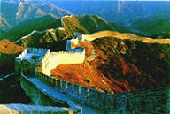 The
Great Wall, symbolizing China's ancient civilization,
is one of the world's most renowned projects. It
is a distance of 75 kilometres northwest of Beijing.
Its highest point at Badaling is some 800 metres
above sea level.Construction of the Wall first began
during the period of the Warring States (476 - 221
BC). The Great Wall which we are going to visit
was rebuilt during the Ming Dynasty in the 16th
century. It extends from Shanhaiguan Pass, a seaport
along the coast of Bohai Bay, to Jiayuguan Pass
in Gansu Province. Its total length is more than
6,700 kilometres. The
Great Wall, symbolizing China's ancient civilization,
is one of the world's most renowned projects. It
is a distance of 75 kilometres northwest of Beijing.
Its highest point at Badaling is some 800 metres
above sea level.Construction of the Wall first began
during the period of the Warring States (476 - 221
BC). The Great Wall which we are going to visit
was rebuilt during the Ming Dynasty in the 16th
century. It extends from Shanhaiguan Pass, a seaport
along the coast of Bohai Bay, to Jiayuguan Pass
in Gansu Province. Its total length is more than
6,700 kilometres. |
The Ming Tombs
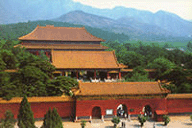 The
Ming Tombs was built under the order of the third
emperor of the Ming Dynasty, Emperor Yongle.As a
frontier commander, he was aware that a peaceful
northern frontier was of great importance to the
Ming Palace, he chose this valley to build his tomb.
All his successors followed his example and had
their tombs built here, except one who was dethroned
and buried in the western suburb. Out of the sixteen
emperors, thirteen lie here with their empresses
and concubines.The tombs are located about 50 kilometres
to the north of Beijing. The
Ming Tombs was built under the order of the third
emperor of the Ming Dynasty, Emperor Yongle.As a
frontier commander, he was aware that a peaceful
northern frontier was of great importance to the
Ming Palace, he chose this valley to build his tomb.
All his successors followed his example and had
their tombs built here, except one who was dethroned
and buried in the western suburb. Out of the sixteen
emperors, thirteen lie here with their empresses
and concubines.The tombs are located about 50 kilometres
to the north of Beijing. |
The Summer Palace
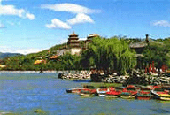 The
construction of the Summer Palace first started
in 1750. The monarch in power then was Emperor Qianlong.
he summoned skillful and ingenious artisans from
all over the country to carry out this construction
work in honor of his mother's birthday. The
construction of the Summer Palace first started
in 1750. The monarch in power then was Emperor Qianlong.
he summoned skillful and ingenious artisans from
all over the country to carry out this construction
work in honor of his mother's birthday.
Characterized by its vast scope and rich cultural
embodiments, the Summer Palace has become one of
the most famous tourist sites in the world.
|
The Temple of Heaven
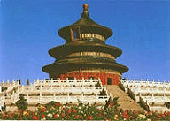 The
Temple of Heaven is one of the most strictly protected
and preserved cultural heritages of China. There
are 12 million visitors every year. The Circular
Mound Altar The largest group of architectures ever
to be dedicated to Heaven, the Temple of Heaven
served as an exclusive altar for Chinese monarchs
during the Ming and Qing dynasties. It was decreed
that rulers of successive dynasties would place
altars in their own capitals to worship Heaven and
pray for good harvest. The
Temple of Heaven is one of the most strictly protected
and preserved cultural heritages of China. There
are 12 million visitors every year. The Circular
Mound Altar The largest group of architectures ever
to be dedicated to Heaven, the Temple of Heaven
served as an exclusive altar for Chinese monarchs
during the Ming and Qing dynasties. It was decreed
that rulers of successive dynasties would place
altars in their own capitals to worship Heaven and
pray for good harvest. |
Tian'anmen (Gate of
Heavenly Peace)
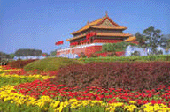 The
symbol of New China, this gate was built in 1417
and renovated in 1981. It was originally called
the Gate of Heavenly Succession. The late Chairman
Mao proclaimed the founding of the People's Republic
of China on the rostrum on October 1st, 1949.
The gate has five passages, which were closed
and used onlyon ceremonial occasions in the old
days. The emperor alone was entitled to pass through
the central passage. The
symbol of New China, this gate was built in 1417
and renovated in 1981. It was originally called
the Gate of Heavenly Succession. The late Chairman
Mao proclaimed the founding of the People's Republic
of China on the rostrum on October 1st, 1949.
The gate has five passages, which were closed
and used onlyon ceremonial occasions in the old
days. The emperor alone was entitled to pass through
the central passage.
Tian'anmen Square
Tian'anmen Square
occupies an area of 49 hectares (122 acres), big
enough to hold half a million people. The square
has witnessed the Chinese people's struggle against
foreign aggression and reactionary rule at home.
Many tourists to Tian'anmen Square would like
to have their pictures taken in front of the white
marble Jinshuiqiao (Gold Water Bridges). |
Lugouqiao ( Marco Polo)
Bridge
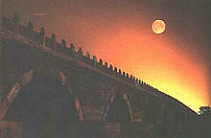 Lugouqiao
(literally the Bridge Over the Reed Ditch) has been
made famous by at least three historic events: Marco
Polo's description, Emperor Qianlong's inscription
and the outbreak of the War against the Japanese
Aggressors. Officially the bridge was called the
"Lugou Stone Bridge", and it was built
completely of white stone and looked majestic with
a total of 485 stone lions lined on the balustrades
of both sides. Almost from its very inception, namely
in the Mingchang period (1190-1208) of the Jin Dynasty,
the bridge was listed by travellers and men of letters
as one of the "Eight Scenic Spots of Yanjing
(Beijing)" under the descriptive title "Lugou
Xiaoyue" or Moon Over Lugou at Daybreak (The
Morning Moon Over Lugou Bridge ). Lugouqiao
(literally the Bridge Over the Reed Ditch) has been
made famous by at least three historic events: Marco
Polo's description, Emperor Qianlong's inscription
and the outbreak of the War against the Japanese
Aggressors. Officially the bridge was called the
"Lugou Stone Bridge", and it was built
completely of white stone and looked majestic with
a total of 485 stone lions lined on the balustrades
of both sides. Almost from its very inception, namely
in the Mingchang period (1190-1208) of the Jin Dynasty,
the bridge was listed by travellers and men of letters
as one of the "Eight Scenic Spots of Yanjing
(Beijing)" under the descriptive title "Lugou
Xiaoyue" or Moon Over Lugou at Daybreak (The
Morning Moon Over Lugou Bridge ). |
The Ruins of Yuanmingyuan
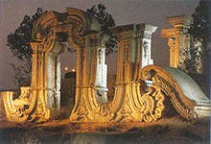 Yuanmingyuan
or the Garden of Perfection and Brightness, located
on the northwestern outskirts of Beijing, is one
of the five famous gardens built during the Qing
Dynasty.Yuanmingyuan actually included three separate
gardens. And the three put together covered an area
of nearly 350 hectares. Unfortunately, when the
Anglo-French forces invaded Beijing in 1860, the
whole grounds were set on fire. In 1900, Yuanmingyuan
was again plundered by two Allied Forces of the
Eight Powers. Warlords and bandits stole or destroyed
what was left. Now, outlines of the imperial garden
can still be traced, and much of the area has been
planted with trees. Paths and bridges have been
renovated. A museum has been set up showing the
history of Yuanmingyuan and plans for its future
restoration. Yuanmingyuan
or the Garden of Perfection and Brightness, located
on the northwestern outskirts of Beijing, is one
of the five famous gardens built during the Qing
Dynasty.Yuanmingyuan actually included three separate
gardens. And the three put together covered an area
of nearly 350 hectares. Unfortunately, when the
Anglo-French forces invaded Beijing in 1860, the
whole grounds were set on fire. In 1900, Yuanmingyuan
was again plundered by two Allied Forces of the
Eight Powers. Warlords and bandits stole or destroyed
what was left. Now, outlines of the imperial garden
can still be traced, and much of the area has been
planted with trees. Paths and bridges have been
renovated. A museum has been set up showing the
history of Yuanmingyuan and plans for its future
restoration. |
The World Park in Beijing
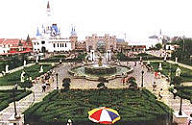 Located
in the Fengtai District of Beijing 16 kilometres
from the city proper, the World Park in Beijing
features 106 of the most famous sites from 14 countries
and regions the world over.The park, measuring 46.7
hectares (116.75 acres) in size, consits of two
parts: The scenic area in miniature displayed according
to the position of its country on the map, and a
shopping, dining and enteratinment area. The park
includes most of the recognized spots of interest
on the globe. Lawns in the park are dotted with
100 well-known sculptures, among them the Statue
of Liberty, the Little Mermaid from Copenhagan,
Michelangelo's David and the Venus de Milo.Regular
international parades of folklore are planned to
provide the tourist with a chance to view folk customs
from different countries. Located
in the Fengtai District of Beijing 16 kilometres
from the city proper, the World Park in Beijing
features 106 of the most famous sites from 14 countries
and regions the world over.The park, measuring 46.7
hectares (116.75 acres) in size, consits of two
parts: The scenic area in miniature displayed according
to the position of its country on the map, and a
shopping, dining and enteratinment area. The park
includes most of the recognized spots of interest
on the globe. Lawns in the park are dotted with
100 well-known sculptures, among them the Statue
of Liberty, the Little Mermaid from Copenhagan,
Michelangelo's David and the Venus de Milo.Regular
international parades of folklore are planned to
provide the tourist with a chance to view folk customs
from different countries. |
Prince Gong's
Mansion (Residence of The Last Qing Emperor's Father)
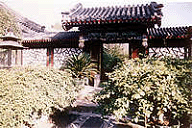 The
Mansion is the most exquisitely decorated and best
preserved of the princes' mansions in the capital
city. Besides the residence there is also a large
garden. Nowadays, a few such mansions dating from
the Ming Dynasty are still standing. These gardens
are ingeniously constructed with complementary buildings
and terraces, well spaced vegetation and hill paths
that wind their way around cool and tranquil grottos.
They are an exquisite combination of classical Chinese
architecture and tasteful landscape. The
Mansion is the most exquisitely decorated and best
preserved of the princes' mansions in the capital
city. Besides the residence there is also a large
garden. Nowadays, a few such mansions dating from
the Ming Dynasty are still standing. These gardens
are ingeniously constructed with complementary buildings
and terraces, well spaced vegetation and hill paths
that wind their way around cool and tranquil grottos.
They are an exquisite combination of classical Chinese
architecture and tasteful landscape. 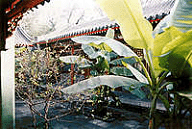 |
|
The China Millennium
Monument
|
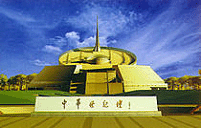 All
over the world, celebrations and festivities to
usher in Year 2000 make up one of the grandest
spectacles at the end of the century, as mankind
strides towards the new century and millennium. All
over the world, celebrations and festivities to
usher in Year 2000 make up one of the grandest
spectacles at the end of the century, as mankind
strides towards the new century and millennium.
At the turn of the century and millennium, the
China Millennium Monument. with its oriental cultural
overtones and contemporary architectural art,
will promote the national spirit by embodying
an original style, displaying a modern aestheticism,
and expressing hopes of the future.
|
The Altar of
Earth
 Built
in 1530, the Altar of Earth is extended over an
area of 37 hectares, it was surrounded by a double
square enclosure. The outer enclosure no longer
stands but its west gate remains. For more than
four centuries, the Altar of Earth was the sacred
place where the emperors of the Ming (1368-1644)
and Qing (1644-1911) dynasties worshipped the God
of Earth. The place, formally reopened in 1984,
has been converted into a park mainly serving the
aged. Built
in 1530, the Altar of Earth is extended over an
area of 37 hectares, it was surrounded by a double
square enclosure. The outer enclosure no longer
stands but its west gate remains. For more than
four centuries, the Altar of Earth was the sacred
place where the emperors of the Ming (1368-1644)
and Qing (1644-1911) dynasties worshipped the God
of Earth. The place, formally reopened in 1984,
has been converted into a park mainly serving the
aged. |
Back>>
|